THE EVIDENCE

What the numbers show.

Results from a demonstration dataset of 4,402 recorded head-motion events in elite women's ice hockey — presented here as reported, with methods and limitations alongside.

STUDY SNAPSHOT
34
elite players, 2 Finnish national-league women's ice-hockey teams
19
consecutive matches, September–October 2025
4,402
recorded events, ACT Head Impact Tracker Pro, mastoid placement
187 m/s²
median peak acceleration (range 44–2,841; 75th pct. 315)
01 · DIMENSIONALITY & ORTHOGONALITY

Two very different shapes of information

Principal component analysis on the full dataset (n = 4,402) quantified how many independent dimensions each feature set actually contains.

Peak kinematic set — 6 variables
2 components → 96.4%

The first component alone explains 76.3% of variance. High collinearity among peak-magnitude measures means this feature set is effectively one-dimensional — a ranking of events by intensity, and nothing more.

IFS structural set — 111 variables
14 components → 80%

The first component explains 25.0% of variance; the first two together, 38.3%. Variance is distributed across multiple independent mechanical dimensions rather than concentrated in one.

Orthogonality
55.3% of IFS variance is orthogonal to the peak set

More than half the information in the IFS structural representation cannot be recovered from any linear combination of peak metrics. This is read as an indicator of non-redundant information content — not proof of causal independence — and it means the two representations are mutually non-predictive: neither can be reconstructed from the other.

02 · EVENT SEPARATION

On-ice vs. off-ice, in the full dataset

Projected onto their first two principal components, the traditional feature space showed substantial overlap between on-ice events (n=367) and off-ice events — on-bench, warm-up, intermission, post-game (n=4,035) — with no clear spatial boundary. The IFS structural space showed a partially different organization, with on-ice events occupying a more distinct region.

Linear discriminant analysis with stratified five-fold cross-validation quantified this numerically:

Feature setBalanced accuracySensitivityROC-AUC
Peak kinematic (traditional)50.0%0.0%64.8%
IFS structural59.0%—82.2%

Class imbalance 11.0:1 (n = 4,402). Zero sensitivity for the traditional set reflects that a single-dimension feature space cannot separate classes that vary across multiple mechanical dimensions.
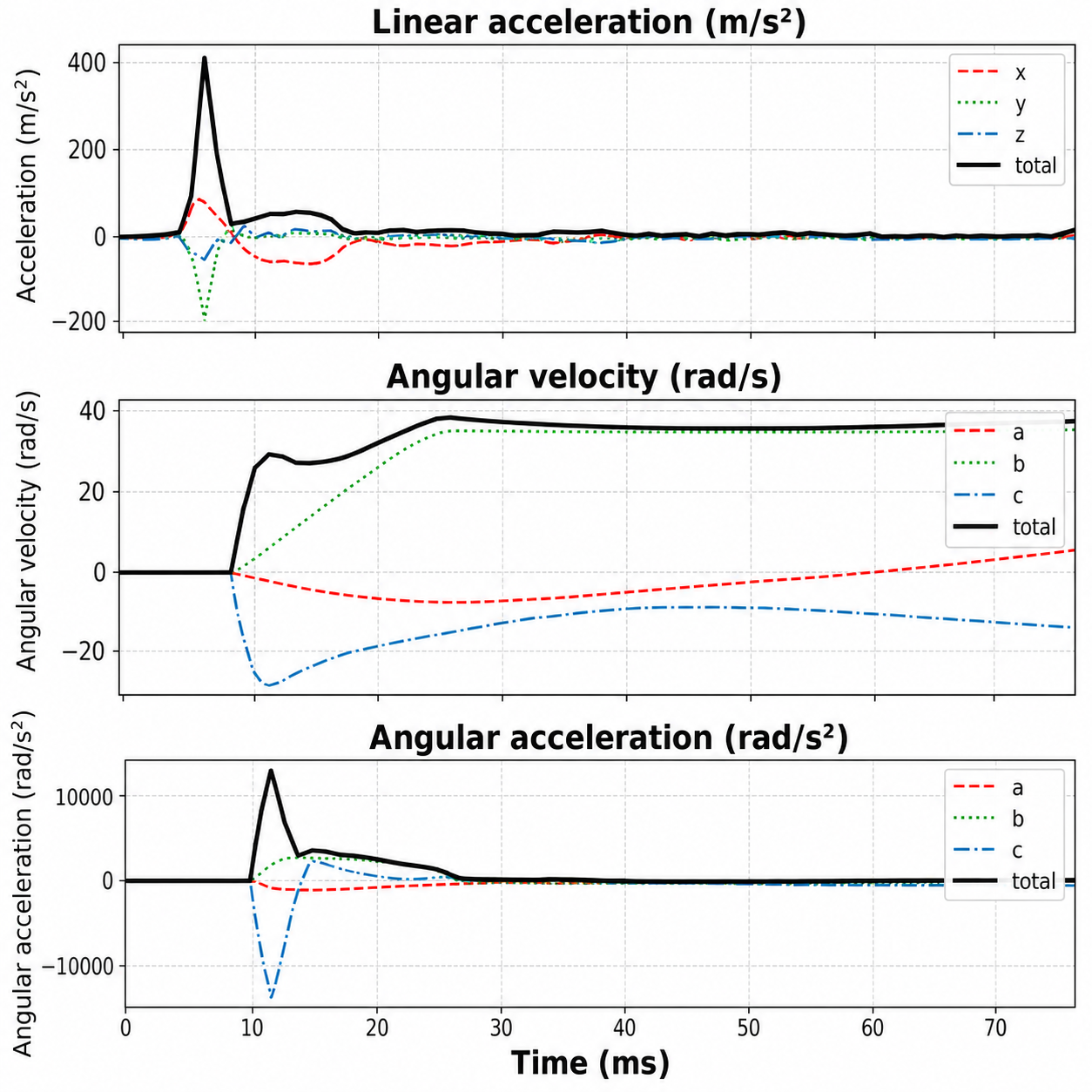
A recorded head-motion event: linear acceleration, angular velocity, and angular acceleration over 75 milliseconds.
Fig. 1 — Recorded impact waveform, single event, live ice-hockey gameplay. Linear acceleration (top), angular velocity (middle), angular acceleration (bottom), x/y/z components and resultant.
03 · STRUCTURAL MEASURES THAT SEPARATE THE CLASSES

What actually differs, mechanically

Mann–Whitney U tests across the full dataset identified IFS structural measures with large, mechanically interpretable differences between on-ice and off-ice events.

MeasureOn-ice (median)Off-ice (median)Effect size |rbc|
Linear acceleration kurtosis6.078.500.348
Waveform skewness1.882.370.340
Duration above 10% of peak54 ms44 ms0.208
Rotational-to-linear peak ratio6.894.940.191

All p < 0.001. On-ice events show lower kurtosis and skewness — wider, more symmetrical waveforms than the narrow, highly peaked transients typical of off-ice events — plus longer sustained loading and stronger rotational–translational coupling. Offered as a mechanistic illustration, not an exhaustive analysis: sustained impacts transmitted through mass and tissue produce extended temporal and mechanical complexity, while sensor disturbances produce brief, rotationally uninformative transients.

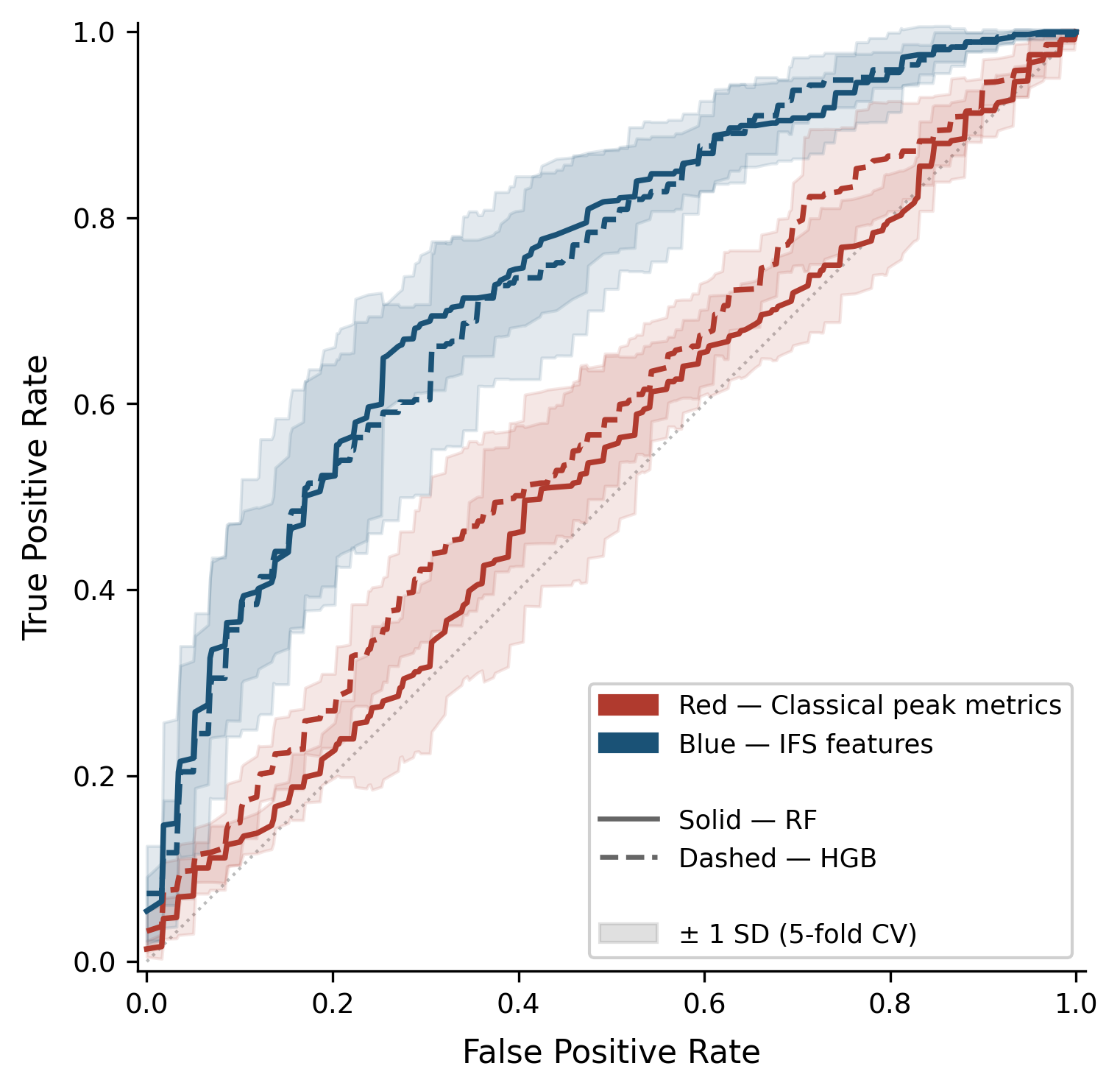
ROC curves: peak metrics versus IFS features, random forest and histogram gradient boosting, classifying on-ice versus bench events.
Fig. 2 — ROC curves, on-ice vs. bench-seated classification during active gameplay (n=661). Red: peak metrics. Blue: IFS features. Solid: random forest. Dashed: histogram gradient boosting. Shaded bands: ±1 SD, 5-fold CV.
04 · APPLIED CLASSIFICATION (n = 661)

A conservative, task-agnostic test

Restricted to gameplay periods only — on-ice (n=367) vs. bench-seated (n=294), both within the same time frame and both above the detection threshold — so classification necessarily reflects waveform structure, not timing.

Feature setBalanced acc.ROC-AUC (RF)ROC-AUC (HGB)
Peak metrics (6 var.)53.2% ±3.153.0%55.9%
IFS (111 var.)67.4% ±3.574.2%73.2%
Combined (117 var.)—74.0%73.5%

IFS variables were entered without task-specific feature selection or tuning. Combining feature sets added no discriminative power over IFS alone — consistent with orthogonality: peak metrics carry no information IFS doesn't already contain for this task. Of the top 20 features by importance in the combined model, all 20 came from the IFS set: waveform kurtosis, vibration clearance, phase decay time, spectral entropy, and VBA rotational path length ranked highest.

METHODS, BRIEFLY

How this was analyzed

Signals sampled at 1000 Hz, angular velocity low-pass filtered (4th-order Butterworth, 165 Hz cutoff). PCA on standardized variables; orthogonality computed as residual variance after projecting IFS variables onto the traditional principal-component space. Random forest (300 trees) and histogram gradient boosting classifiers, stratified 5-fold cross-validation, balanced class weights. Python 3.12, scikit-learn 1.4, SciPy 1.13.

LIMITATIONS

What this dataset does not show

Demonstration data come from two Finnish women's ice-hockey teams over 19 matches; generalizability to other sports, populations, or levels of play falls outside the current work. No injury-outcome data were available, so no relationship between IFS structural features and injury was — or could be — examined here. The feature set was designed for this sensor system and mastoid placement, and needs independent validation for other systems.

Where could this go next?

Exploratory, unpublished thinking on other sports and applications — clearly marked as hypothesis, not evidence.

See the applications →